


November 12, 2026 | Black & Kletz Allergy
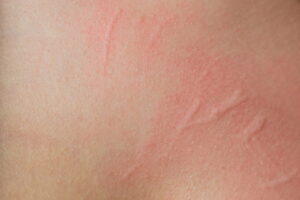 Dermatographism is a condition in which there is an exaggerated response of the skin to the physical stimulus of stroking, rubbing, or pressing with an object. The term literally means to “write on the skin.” It is the most common form of physical urticaria. A wheal and flare response can be seen minutes after stroking the patient’s skin.
Dermatographism can be divided into simple dermatographism and symptomatic dermatographism. Simple dermatographism is a normal physiologic process where the skin becomes raised and inflamed after being stroked (i.e., scratched, rubbed) or undergoing friction. It is usually not associated with itching and generally resolves spontaneously after a few minutes. Symptomatic dermatographism, on the other hand, involves an exaggerated physiologic response that results in itching and burning of the involved area and this reaction can last for hours, as opposed to a few minutes.
Causes of Symptomatic Dermatographism:
Most cases of symptomatic dermatographism are described as idiopathic, which is a fancy term for saying that we do not know the cause as there appears to be no identifiable cause or origin of the symptoms. Although we may not be able to identify a cause, it occurs more commonly in association with the following conditions:
- Systemic diseases: Hyperthyroidism; type 2 diabetes mellitus; mast cell disease
- Drug reactions: Examples include amoxicillin, cefaclor, atorvastatin (i.e., Lipitor)
- Infections: Streptococcus, scabies
- Psychologic: Stress, anxiety
Mechanism of Symptomatic Dermatographism:
The pathogenesis of symptomatic dermatographism is believed to be an exaggerated immunologic response at the level of the mast cell, which is characterized by either excessive histamine degranulation or a lower threshold for degranulation. The exact trigger for this degranulation is unknown. One theory suggests that mechanical trauma releases an unknown antigen that interacts with the IgE receptors on mast cells. Note that mast cells are types of white blood cells that are a component of one’s immune system. They reside in connective tissues, especially the skin, nose, sinuses, lungs, blood vessels, nerves, and digestive tract, and contain granules filled with chemicals such as histamine, heparin, tryptase, leukotrienes, and cytokines. Mast cells play an active role in allergic reactions and inflammation. Their main job is to protect one’s body from infections and help regulate allergic and inflammatory reactions.
Diagnosis of Symptomatic Dermatographism:
Symptomatic dermatographism is suspected when tight clothing over the body (e.g., belts, waistbands, wristbands) cause very itchy hives or welts that may last for hours.
The diagnosis can be made in the clinical setting by simply stroking the patient’s skin with a tongue depressor blade, unopened ball-point pen, or any other similar blunt object. Dermatographism is easily elicited on the forearms or on the back. The hives usually appear in the shape of the stroke.
Laboratory tests such as blood counts and urinalysis are usually normal. A fasting blood sugar and thyroid function tests may help in detecting associated systemic disorders. A skin biopsy specimen may prove useful to rule out other conditions in the differential diagnosis including systemic mastocytosis or connective tissue diseases, especially if the patient has a persistent fever, joint pain, fatigue, and/or achiness.
Treatment of Symptomatic Dermatographism:
Therapy consists of avoiding precipitating physical triggers by wearing loose-fitting clothing, as well as reducing stress and anxiety. The primary treatment of symptomatic dermatographism is the use of a nonsedating antihistamine or H-1 receptor blocker [e.g., Claritin (loratadine), Allegra fexofenadine), Zyrtec (cetirizine), Xyzal (levocetirizine), Clarinex (desloratadine)]. More severe cases, unresponsive to the standard daily doses of these medications, may require higher doses in order to successfully treat the dermatographism with doses sometimes reaching up to 4 times higher than the standard dose.
Occasionally, the addition of an H-2 receptor blocker such as Pepcid (i.e., famotidine), dosed once or twice daily may offer additional benefit in terms of reducing the annoying symptoms of dermatographism. Doxepin, an antidepressant used primarily at bedtime, blocks both H1 and H2 receptors. It should be acknowledged that the side-effect profile is considerable for doxepin, including increased sedation and anticholinergic effects such as dry mouth, constipation, urinary retention, and blurred vision. Leukotriene antagonists also have been shown to be more beneficial than placebo in some clinical trials and can be prescribed as an adjunct to antihistamine therapy. Singulair (i.e., montelukast is the most used drug in this class.
A few studies have demonstrated that eating can trigger or aggravate symptomatic dermatographism and exercise can dampen the disease activity. So, exercising before and after eating can reduce the severity of symptoms in those who experience more frequent symptoms after eating.
New Treatment of Symptomatic Dermatographism:
On October 7, 2026, the FDA approved Rhapsido (i.e., remibrutinib) as the first treatment for adults with symptomatic dermatographism inadequately controlled by H-1 antihistamines. Rhapsido blocks the BTK (i.e., Bruton’s tyrosine kinase) pathway involved in the release of histamine and other inflammatory mediators. Rhapsido is administered orally twice daily with or without food. Of note, Rhapsido also has an FDA-approved indication for the treatment of chronic spontaneous urticaria, also known as chronic hives due to an unknown etiology. It is important to note that Rhapsido carries a bleeding risk, and precautions are needed around surgery and with certain blood-thinning medications.
The board certified allergy doctors at Black and Kletz Allergy have over 5 decades of experience in diagnosing and treating all types of allergic skin disorders including spontaneous dermatographism, hives (i.e., urticaria), swelling episodes (i.e., angioedema), generalized itching (i.e., pruritus), and atopic dermatitis (i.e., eczema). Our allergists treat both adult and pediatric patients. Black & Kletz Allergy has 3 convenient locations with on-site parking located in Washington, DC, McLean, VA (Tysons Corner, VA), and Manassas, VA. The Washington, DC and McLean, VA offices are Metro accessible and we offer a free shuttle that runs between the McLean, VA office and the Spring Hill metro station on the silver line. To schedule an appointment, please call any of our offices or you may click Request an Appointment, and we will respond within 24 hours by the next business day. We have been servicing the greater Washington, DC metropolitan area for many decades and we look forward to providing you with the utmost state-of-the-art allergy care in a friendly and pleasing environment.