


February 03, 2026 | Black & Kletz Allergy
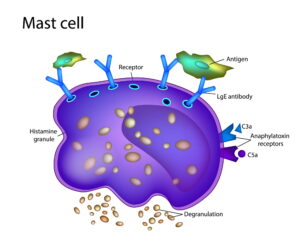 Mast cell activation syndrome (MCAS) is caused by episodic abnormal release of chemical mediators stored in the granules of mast cells which may affect any organ system. The organ systems most affected tend to involve the skin, gastrointestinal tract, nervous system, and cardiovascular system primarily. Although the prevalence of mast cell activation syndrome varies a lot depending on the source, it is pretty clear that the prevalence has been increasing over recent 5-10 years, particularly since the coronavirus pandemic. The syndrome tends to affect women more than men.
What is a mast cell?
A mast cell is a type of specialized white blood cell that serves as the “alarm system” for the immune system. Unlike normal white blood cells which circulate in the bloodstream, mast cells are found in the connective tissues of the body, especially in areas that interface with the external environment, such as the skin, gastrointestinal tract, and lungs. Mast cells use their receptors on their surface to detect “intruders” such as allergens, bacteria, viruses, and/or parasites. When a mast cell notices a threat, it “degranulates,” a procedure where it quickly bursts open hundreds of tiny sacs (i.e., granules) which in turn releases chemical mediators that were stored in those granules. As a result, chemical mediators (i.e., histamine, heparin, tryptase, cytokines) signal other immune cells to rush to the area. They cause blood vessels to expand, leading to flushing and swelling, as well as muscles to contract, causing coughing or gastrointestinal tract symptoms, in order to help flush out the threat.
What does each chemical mediator do?
As mentioned above, the key chemical mediators released from mast cells and their primary effect are as follows:
- Histamine – Increases blood flow and causes itching, swelling, and mucus production.
- Heparin – Prevents blood clotting to keep blood flowing to the affected area.
- Tryptase – An enzyme used as a marker for mast cell activity; It helps break down tissue to allow immune cells to move.
- Cytokines – Small proteins that recruit other immune cells and signal the body to create more white blood cells.
Triggers
In mast cell activation syndrome, the mast cells become “overprotective” or “hypersensitive,” causing them to release these powerful chemicals in response to harmless triggers such as stress, heat, certain foods, and/or odors. Some of the more common triggers of mast cell activation syndrome are as follows:
- Emotional and Physical Stress – Emotional trauma or anxiety and physical stressors such as pain, major surgery, and/or lack of sleep.
- Environmental Factors – Extreme heat, extreme cold, sudden changes in temperature, high humidity, and/or sunlight.
- Food and Drink – High histamine foods: Alcohol (especially beer and red wine), fermented foods (e.g., aged cheeses, soy sauce, sauerkraut, kombucha), chocolate, tomatoes, citrus fruits, pineapples, kiwi, bananas, strawberries, papayas, plums, spinach, eggplant, peanuts, walnuts, cashews, chickpeas, cured meats, food additives (e.g., MSG, artificial dyes), ketchup, mustard, and/or shellfish
- Odors and Chemicals – Fragrances (i.e., perfumes, colognes), cigarette smoke, cleaning supplies, pesticides, and/or “new car” or “new carpet” smells.
- Physical Stimuli – Friction or vibration on the skin (i.e., rubbing, tight clothing), and/or intense exercise.
- Hormonal Changes – Fluctuations in estrogen levels (i.e., estrogen treatment, menstruation, pregnancy, menopause)
- Infections – Bacterial, viral, or fungal infections (e.g., COVID-19, influenza, strep. infection).
- Insect Bites/Stings – Venom from bee, wasp, yellow jacket, hornet, and/or fire ant stings
- Medications – Nonsteroidal anti-inflammatory drugs (NSAIDs) such as ibuprofen (e.g., Motrin, Advil), naproxen (e.g., Aleve, Naprosyn), opioids (e.g., codeine, morphine), aspirin, certain antibiotics, and/or contrast dyes used in medical imaging (e.g., IV radiocontrast dye)
Since triggers can change over time, many patients use a symptom and trigger journal to identify patterns. It is often recommended to try a “bucket theory” approach: individual small triggers might be fine on their own, but when they add up (i.e., stress plus a high-histamine meal), the “bucket” overflows and causes a reaction.
Lifestyle Changes
An individual with mast cell activation syndrome should try to maintain a balanced temperature control. Since heat is a substantial trigger, many patients use cooling vests or portable fans to avoid getting overheated. Staying in air-conditioned places is probably the best option. One should avoid scalding hot showers, as lukewarm water is the safest bet for these individuals.
Product switching such as a transition to “fragrance-free” and “hypoallergenic” detergents and soaps is recommended. Even “natural” scents like essential oils can be potent triggers for individuals with hypersensitive mast cells.
Reducing stress is important in many patients. Emotional stress causes the brain to release corticotropin-releasing hormone (CRH), which directly activates mast cells. Techniques to relieve stress such as gentle meditation may help dampen this physical response in some individuals.
Wearing loose-fitting clothing with natural fibers (i.e., organic cotton, silk) may be helpful for certain individuals with itching or swelling. Tight elastic or synthetic fabrics may cause “mechanical” triggering of the mast cells through friction.
Medication Treatment
The medications used to treat mast cell activation syndrome should try to relieve the annoying symptoms that many find infuriating. Hstamine-1 antihistamines (H1-blockers) are efficacious in decreasing many of the symptoms in some patients. Histamine-2 antihistamines (H2 blockers) may work in conjunction with the H1 blocking antihistamines to give better relief. Leukotriene antagonists [i.e., Singulair (montelukast), Accolate (zafirlukast), Zyflo (zileuton) may also offer additional help in relieving unwanted symptoms. These leukotriene antagonists help the patient by blocking the effects of leukotriene C4 (LTC4) or 5-lipoxygenase (5-LPO), depending on the leukotriene antagonist used. Mast cell stabilizers (i.e., cromolyn sodium) may be beneficial in that they stabilize mast cell membranes, thus decreasing degranulation, and causing less of the chemical mediators to be circulated into the tissues. Aspirin and NSAID’s (nonsteroidal anti-inflammatory agents) have a role in treatment, particularly in individuals who suffer from flushing, as these medications block the production of the chemical mediator prostaglandin D2 (PGD2). In recalcitrant cases, patients should carry a self-injectable epinephrine device (i.e., EpiPen, Auvi-Q, Adrenaclick) or Neffy, an epinephrine containing nasal spray, as a precaution. If the epinephrine is used by the patient, the individual should then go to the closest emergency room. Although not FDA-approved to treat mast cell activation syndrome, Xolair (i.e., omalizumab), a monoclonal antibody that prevents the binding of the IgE molecules to its receptors, has been reported to decrease mast cell reactivity and sensitivity to activation which can reduce anaphylactic episodes.
The board certified allergy specialists at Black & Kletz Allergy have been diagnosing and treating mast cell activation syndrome for many years. We treat both pediatric and adult patients. Black & Kletz Allergy has offices in Washington, DC, McLean, VA (Tysons Corner, VA), and Manassas, VA. All 3 of our offices have on-site parking. For further convenience, our Washington, DC and McLean, VA offices are Metro accessible. Our McLean office location offers a complementary shuttle that runs between our office and the Spring Hill metro station on the silver line. For an appointment, please call our office or alternatively, you can click Request an Appointment and we will respond within 24 hours by the next business day. If you suffer from symptoms consistent with mast cell activation syndrome, we are here to help improve or hopefully end these unwanted symptoms that have been so troublesome, so that you can enjoy a better quality of life. Black & Kletz Allergy is dedicated to providing the highest quality allergy care in a calm, compassionate, and professional atmosphere.